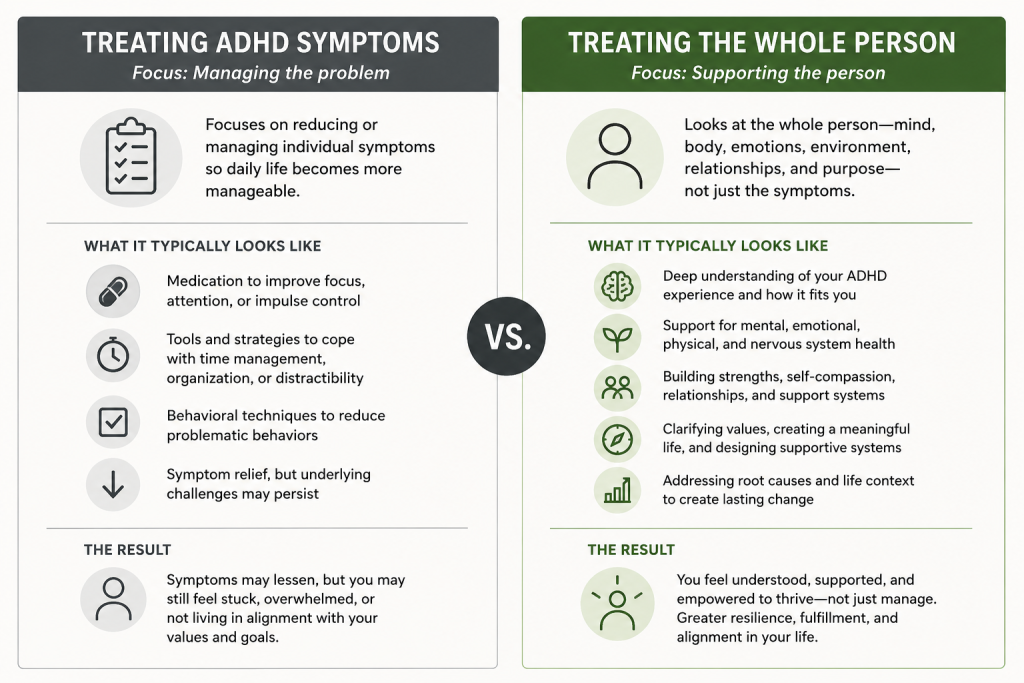

There is limited research on “successfully treating” ADHD and much of it focuses on response to medication. And what responses are we looking at? Reduction of the narrowly defined symptoms of ADHD as defined in the DSM-5. Research tries to measure what is clear and definable – but life is messy and not too clear, especially when it comes to ADHD!
While improved focus and decreased impulsivity are important, life with ADHD is so much more complex than that. It reminds me a bit of my recent experience with a shoulder replacement. The surgeon took post-surgical x-rays and declared that everything looked perfect. The only problem was that months after my surgery, I still experienced repeated piercing pain. I returned, he repeated the x-ray, and said everything looked as it should. He was paying attention to bones and joints, not muscles and tendons, not my pain while doing normal activities. He was a fine surgeon, and he’d done a perfect job of replacing the shoulder joint. But in my daily life, things weren’t perfect at all. I sought a consult from another orthopedic surgeon who confirmed the success of the surgery, but also referred me to a physical therapist whom he called a “wizard” in fixing post -surgical problems. In fact, she was a wizard. She didn’t just consider the joint. She took a broader view of my shoulder, carefully considering the specific movements that led to intense pain. She analyzed the tiny, discrete muscles that were still quite weak, despite flexibility in the joint, prescribed very specific exercises (previous PT had been generic), and six weeks later I was pain free. She had taken a broader view of the treatment I needed to have a well-functioning shoulder.
Don’t Ignore ALL The Factors
Why am I writing about my shoulder replacement, you might wonder. Because initially, the treatment success for my damaged shoulder was defined too narrowly. The treatment “fixed” the damaged joint, but didn’t consider muscles and tendons surrounding it. Just as when we measure ADHD treatment only in terms of the DSM-5 defined criteria, treatment “success” ignores the broader picture of overall quality of life. In treating ADHD, we need to improve focus and impulse control, but we shouldn’t ignore the countless other factors that need attention when treating ADHD.
In the clinical training that we’ll offer through ILAT (Institute for Lifespan ADHD Training), we look at the whole person, about their quality of life and sense of well-being, not just whether they can temporarily, while taking stimulant medication, focus better and have better impulse control. We will train clinicians to go beyond the DSM and go beyond the pill, to look at anything and everything that can improve our cognitive functioning, our sense of well-being and our lives – our relationships, our quality of sleep, and our daily life satisfaction.
Our training will be specifically focused on “what to do about ADHD” and the many skills each clinician needs to master to truly develop expertise in treating ADHD. As clinicians, we need to move beyond referring someone with ADHD to an array of specialists, which places a strain on both finances and schedules. ILAT’s goal is to teach clinicians to put multiple tools in their ADHD toolkit to address the complexity of ADHD. It’s a lot more than “paying attention.”